The realizations that came to Einstein from science are life-affirming. This quote from a letter he wrote to a grieving friend is beautiful:
A human being is part of a whole, called by us the “Universe,” a part limited in time and space. He experiences himself, his thoughts and feelings, as something separated from the rest — a kind of optical delusion of his consciousness. This delusion is a kind of prison for us, restricting us to our personal desires and to affection for a few persons nearest us. Our task must be to free ourselves from this prison by widening our circles of compassion to embrace all living creatures and the whole of nature in its beauty.
Albert Einstein February, 1950 As published in The Quantum and the Lotus
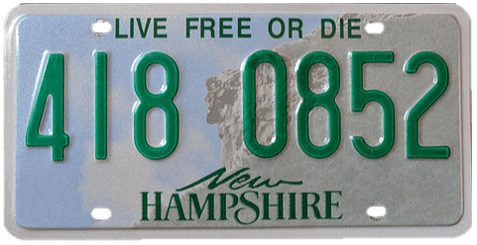
This past week I had the pleasure of traveling along the coast of New England, full of moss and cemeteries and boats and used book stores. Some vanity license plates that were a little off-putting (“GOTBO1Z” particularly stands out). And, of course, New Hampshire’s memorably license plate’d state motto Live Free or Die. Probably the most famous state motto. For good reasons, of course:
It’s understandable
It’s in English, unlike, say Connecticut’s Qui transtulit sustinet (which doesn’t become cooler when translated, trust me)
A simple idea, whereas it feels like Illinois may have overreached with State sovereignty, national union
It’s a motto. This is critical. Some states may have missed this part of the assignment. (Tennessee? Agriculture and Commerce? Really?)
It’s catchy! Iowa, I like where you’re coming from, but Our liberties we prize and our rights we will maintain just doesn’t roll off the tongue.
It’s an ultimatum. No other state uses the word “OR” in their motto.
Very few countries use an “OR” – ultimatums are uncommon at best. Not unheard of though.
The French First Republic’s motto was the ambitious Liberty, Equality, Fraternity, or Death. Good luck, am I right? Also, kinda makes me think of menu options, “Sourdough, Rye, Wheat, or White? Pick ONE.”
Somewhat related, the area of Brittany in Northwest France went with Rather death than dishonour which is good, but just suggests a preference instead of a true ultimatum. Sure, I’d rather die than be dishounoured, if I had to choose. But that’s a big “if”.
Cuba’s got a mouthful, with Homeland or Death, We Shall Overcome! Not bad, but feels like it would help to have more details or context.
And of course Greece, the home of philosophers and philosopher killers: Ελευθερία ή Θάνατος (Freedom or Death)
Mozambique doesn’t need a motto with a flag like that
The uniquely “American-ness” of the New Hampshire motto is partly due to the simplicity of it. To compare flags and mottos: while some flags have the color red to symbolize the bloodshed that earned freedom, Mozambique put a goddamn AK47 on the flag. Live Free or Die is the AK47 of mottos. And there is a “realness” to the statement that other mottos don’t quite capture – the true corporal element to living (free or otherwise) and dying. No abstract ideal of “liberty” or concept of “death”.
Of note: In 1977 the New Hampshire Supreme Court ruled in favor of a Jehovah’s Witness who covered up “or die” on his plate, claiming it violated his religious beliefs. And, according to Wikipedia, a much stupider (but related) case came up a decade later:
In 1987, when New Hampshire introduced new plates with a screened design that had the slogan lightly written on the bottom, some residents complained that the slogan was not prominent enough. One resident cut out the slogan from an older plate and bolted it on the new plate, and was prosecuted for it. The courts ruled in the driver’s favor, presumably basing it on the decision in Maynard.
In this town, I thought to myself, Death sits among the guests at every feast and lies in bed with the lovers. He is present, always and everywhere, like in the woodcuts of Holbein’s Totentanz, but not in the same capacity. In Holbein’s works Death is the uninvited guest whose appearance causes terror and vain despair. Here, he is not regarded as a trap to be avoided by clever men. Here, they do not expect to live to be a hundred and hope to live to be five hundred. Here, no one would dye his hair and beard at the age of fifty, do gymnastics with weights every morning to remain fit. Here they know that even health does not protect against death. Here, death is a welcome guest at the table of friends and when he sits on the edge of the lovers’ bed he does so only to inspire them to even more passionate embraces.




 Death Becomes You