

Death is part of life. All life. Everyone’s lives. We all share it in the biggest sense – like we all share a need for oxygen and a dislike of traffic (but not Traffic). But it’s also something we rarely share. This wasn’t always the case, and sometimes still isn’t – some cultures continue to celebrate death anniversaries and honor the dead collectively. But overall, the western world rarely communes on this particular shared experience.
That’s a shame. Loss and grief can transcend most differences; sharing the feeling (or just knowing others are also trying to cope) can make it much more manageable.
I turn to Emily Dickinson’s “I Measure Every Grief I Meet” for a sense of that shared bond, despite the fact that each person’s grief is a different age, shape, texture. It begins:
I measure every Grief I meet
With narrow, probing, eyes –
I wonder if It weighs like Mine –
Or has an Easier size.

I wonder if They bore it long –
Or did it just begin –
I could not tell the Date of Mine –
It feels so old a pain –
I’ve been thinking of this lately on account of my week at summer camp. Any adult who spends time at a summer camp (I was volunteering as a counselor) will almost certainly confront their mortality. The teenagers, as is their right, behave as though they are immortal, motivated by need for clout and their onset horniness. I was once one of those teens – life was not the opposite of death, but simply all there was. Death was for other, older people. No tree too high climb or hill too steep to ride down. This year, through counselor-tinted lenses, I instead think it might be good to have everyone wear life jackets – at the lake, sure, but maybe the in the pool, and just to be safe, in the shower too. But I held back and did let teenagers be.
It’s worth noting that this was a unique camp, exclusively for kids who’ve lost a parent. So death was very present, but often in the background. And rarely did it get in the way of teenagers being, well, immortal teenagers.
It was a week of aiming to have a very normal summer camp despite what these kids are going through. Losing a parent is tough at any age. But that is only exasperated by a society that avoids any sort of acceptance of death in the course of everyday life. To lose a parent early in life is tragic. And the absence of death as a topic of conversation for both kids and adults means most adults are unprepared to deal with death themselves, let alone help a child through it. Without a guide, a kid doesn’t know how unique and universal their grief is. They don’t realize that this burden that can be shouldered by many, but is instead siloed off to be dealt with individually. One week a year, kids get to hang out with others in the same boat. I’m glad this camp exists. But it’s a bummer this camp needs to exist. Many of the counselors are former campers themselves. Or people who lost a parent and wished for a camp like this all those years ago.
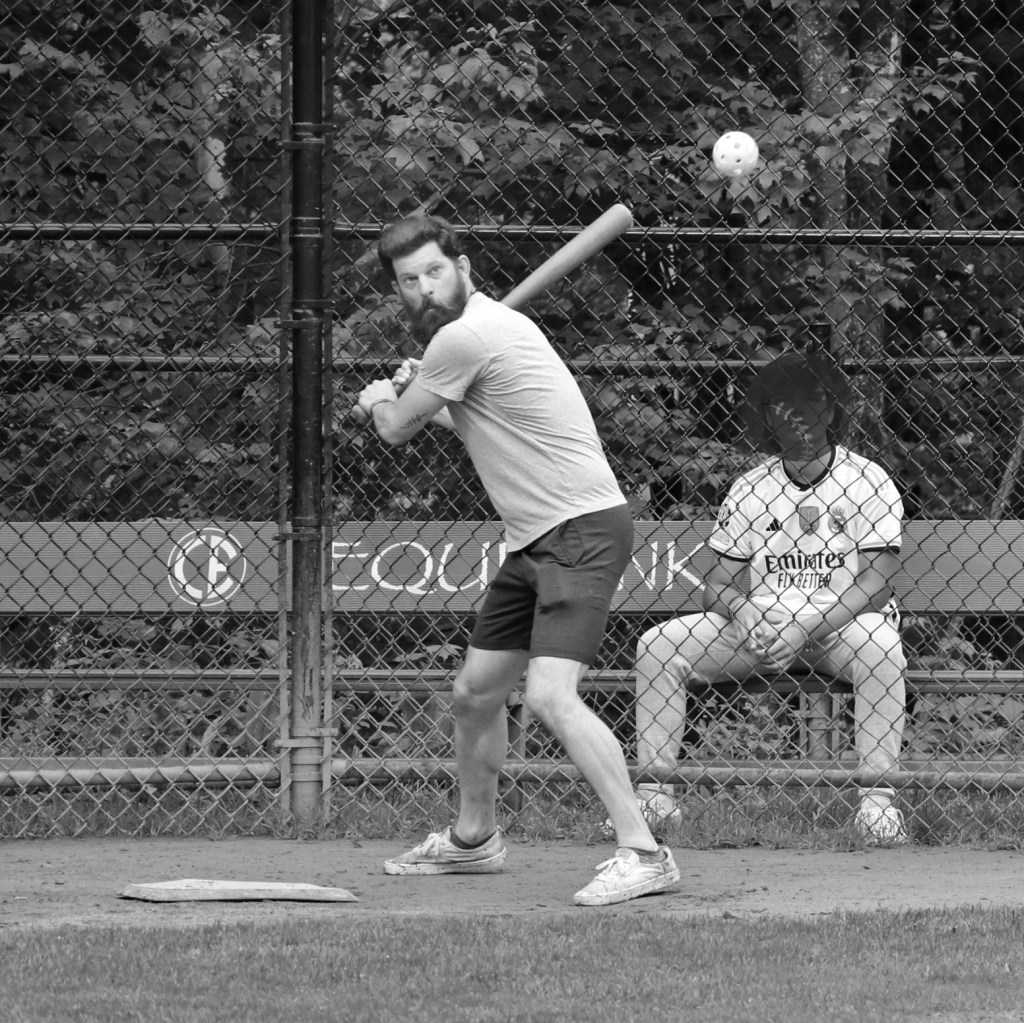
It was a wonderful experience for me as well as all the campers. It was a great chance for these kids to feel at ease in expressing their grief and sadness. And just as importantly, a chance for them to not feel like they have to explain things, have weird conversations, and make others feel uncomfortable on account of their loss. I had one hell of a great time with the kids. We talked about sports, school, death, video games, music, and camp drama. I was bad at whiffleball while still looking like a fairly competent athlete. I was giddy going down a loopy waterslide. I fist-bumped with so many kids and felt great about myself as a result (honestly, I would sign off on a teen giving people fist-bumps at subway stations as a public service).
The kids that I primarily worked with were too old to care much about a playground we walked by most days, but sometimes a couple kids would run ahead and jump on the swings. Old, legacy swings – simple rubber U for a seat. Heavy duty chains bolted to a large and sturdy wooden frame. Fond memories of pumping my legs to get as high as possible – and then feeling the chain go slack, briefly, in free fall. Eventually I’d launch myself off, woodchips embedded in my palms from the landing. Now I’m in charge. And I really didn’t want the kids to play on it. They could get hurt! But that’s similar logic to keeping kids shielded from the reality of death by not talking about it. They’re too young and sensitive. Will “jumping off a big swing” be a useful skill later in life? No. But might we see an increase in confidence? Enthusiasm? Lust of life? Seems worth it. And acknowledging death as part of life doesn’t make death “easy” – but it does mean there’s understanding and confidence. These challenges of life can unite us more than leisure activities ever could. For the kids at camp, it was a rare opportunity for teenagers to be simply be teenagers – bonding on the struggles of growing up – looking to fully embrace life while still reckoning with death.
 Death Becomes You